
Loading
Loading




Understand the true advantages and disadvantages of CRM software so you can choose the solution that drives real growth for your business.
Back to CRM Software OverviewMany business owners view a CRM system as an expense rather than an investment. This "why fix it if it isn't broken" mindset is quietly costing companies market share and pushing customers toward competitors who respond faster and serve better.
A CRM — Customer Relationship Management system — helps businesses keep sales, marketing, and relationship-building goals aligned. By integrating different business departments into a single platform, it enhances overall revenue generation and service quality.
Business owners essentially have three choices: continue without a CRM, keep existing manual processes, or invest in a CRM platform and enjoy the synergy of integrated operations. Understanding the advantages and disadvantages of each CRM type is the first step toward making the right decision.
CRM solutions available on the market today fall into two primary categories: Traditional On-Premise CRM Software and Web-Based/Cloud CRM Software. The advantages and disadvantages of these two groups vary significantly.
On-premise CRM has been in use for far longer than cloud-based alternatives, primarily because early technology could not reliably deliver software solutions over the internet to enterprises of all sizes.
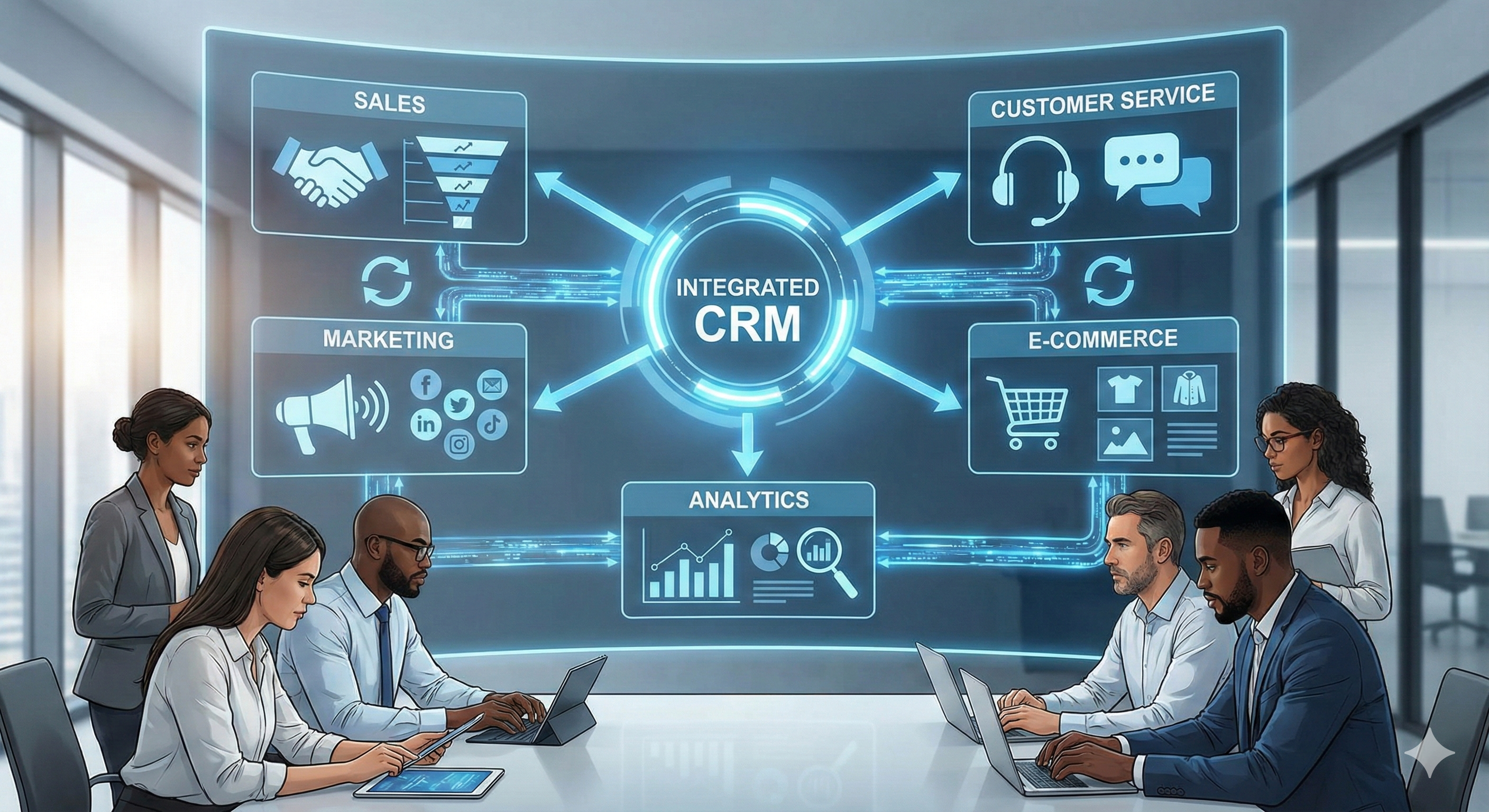
Cloud CRM has transformed how businesses manage customer relationships by eliminating the need for local installations and network cabling entirely. Delivered as Software-as-a-Service (SaaS), it is accessible from any device with an internet connection.

For businesses ready to grow, the advantages of a cloud-based CRM far outweigh the limitations. Here are the most impactful benefits that businesses experience after implementation.
Every interaction, purchase, support ticket, and communication is stored in a single unified record. Teams across sales, service, and marketing all work from the same real-time data — eliminating silos and ensuring a consistent customer experience.
Unlike on-premise solutions that require months of installation and configuration, cloud CRM can be deployed in days. There are no server purchases, no IT infrastructure changes, and no complex networking requirements.
In today's mobile-first world, cloud CRM allows any team member — whether in the office, at a client site, or traveling internationally — to access customer records, update opportunities, and manage tasks in real time from any device.
Cloud CRM providers invest heavily in enterprise-grade security measures including data encryption in transit and at rest, multi-factor authentication, role-based access controls, and automated daily backups that exceed most small business capabilities.
A modern CRM integrates sales, marketing, customer service, HR, inventory management, and financial reporting into one cohesive system. This cross-departmental synergy enables better decision-making, faster response times, and greater overall revenue.
With cloud CRM, businesses know exactly what they'll pay each month with no surprise hardware costs, IT maintenance fees, or expensive upgrade cycles. Budgeting becomes predictable and manageable even for small businesses.
No technology investment is without trade-offs. Understanding the potential disadvantages of CRM software helps businesses prepare for a smoother implementation and long-term success.
Cloud CRM requires internet access. For teams in low-connectivity environments, this can be a limitation — though modern platforms like Salesboom offer offline functionality with automatic sync when the connection is restored.
CRM is only as powerful as the data entered into it. Resistance to change or inconsistent data entry can limit ROI. Addressing this requires proper onboarding, training, and executive sponsorship from day one.
Unlike on-premise systems with a one-time license, cloud CRM involves ongoing monthly or annual fees. However, when total cost of ownership is calculated — including hardware, IT support, and upgrades — cloud CRM is typically more cost-effective.
Moving data from legacy systems or spreadsheets into a new CRM requires planning, cleansing, and validation. Choosing a vendor with dedicated migration support significantly reduces this risk and accelerates time-to-value.
While flexibility is an advantage, excessive customization can make upgrades difficult and create technical debt. Sticking to standard configurations where possible keeps the system sustainable and upgrade-safe over time.
Successful CRM adoption requires training time and resources. However, cloud platforms with intuitive interfaces and strong vendor support make this investment minimal compared to the long-term efficiency gains and revenue growth achieved.
Choosing between on-premise and cloud CRM comes down to your business size, budget, technical resources, and growth plans. Here is a direct comparison across the most critical factors.
| Factor | On-Premise CRM | Cloud / Web-Based CRM |
|---|---|---|
| Deployment Time | Weeks to months | Hours to days |
| Upfront Cost | High (hardware + licenses) | Low (subscription-based) |
| IT Requirements | Dedicated IT team needed | Minimal — vendor-managed |
| Remote Access | Limited / complex VPN | Full access from any device |
| Data Security | Managed internally | Enterprise-grade, vendor-managed |
| Scalability | Hardware-limited | Scales instantly on demand |
| Maintenance / Updates | Manual, costly | Automatic, included |
| Mobile Accessibility | Limited | Full iOS, Android, web support |
| Integration Options | Complex custom builds | Open APIs and native connectors |
| Best For | Large enterprises with strict data sovereignty requirements | SMBs to enterprise, remote or distributed teams |
With more than 22 years of CRM innovation, Salesboom has helped over 3,500 businesses across 159 countries modernize their customer operations. Our Web-Based CRM platform delivers the full advantages of cloud technology with none of the typical disadvantages.
Sales, marketing, customer service, HR, PR, and inventory management — all connected in a single system with no data silos or integration headaches. Every team works from the same unified customer record in real time.
Starting at $14/user/month with no hidden fees, no vendor lock-in, and a predictable subscription model that scales with your team. See the full value before committing with a free 30-day trial — no credit card required.
Out-of-the-box compatibility with Microsoft Outlook, QuickBooks, and an open API for connecting any existing business tools your team already uses — making implementation faster and adoption smoother from day one.
Real CRM specialists — not chatbots — available 24/7 to guide your implementation, answer questions, and help your team get maximum value from the platform throughout the entire customer relationship lifecycle.
Experience the full platform risk-free with complete access to every feature, no credit card required. See firsthand how Salesboom transforms your customer operations before making any commitment to purchase.
22+ years serving 3,500+ businesses across 159 countries. Continuous platform innovation, quarterly feature updates, and AI-powered automation delivered at no additional cost as part of your subscription.
Direct answers to the questions business leaders ask when evaluating CRM solutions and deciding between cloud and on-premise options.
The single greatest advantage of a CRM system is unified visibility. By centralizing customer data — including purchase history, communication logs, service tickets, and preferences — every team member across sales, marketing, and support works from the same real-time information. This eliminates costly miscommunication, speeds up response times, and enables a truly personalized customer experience that drives loyalty and revenue growth.
The most commonly cited disadvantages include: the need for reliable internet connectivity (for cloud CRM), the learning curve and user adoption challenges during onboarding, the ongoing subscription costs over time, and the complexity of migrating data from legacy systems. Most of these challenges can be mitigated by choosing a vendor that offers robust onboarding support, offline functionality, and transparent pricing — such as Salesboom.
For the vast majority of businesses today — especially those with remote teams, field staff, or growth ambitions — cloud CRM is the superior choice. It deploys faster, costs less upfront, scales without hardware investment, and gives employees full mobile access from anywhere. On-premise CRM may be preferable for organizations with strict data sovereignty regulations or those operating in environments without reliable internet access.
Cloud CRM platforms like Salesboom can be deployed and fully operational in as little as a few hours to a few days, depending on the complexity of your setup and data migration needs. This contrasts sharply with on-premise CRM solutions, which can take weeks or months to install and configure across an organization's internal network.
Absolutely. Small businesses often benefit most from CRM because they can establish great customer management habits early, avoid the operational chaos of spreadsheets and manual processes, and scale their operations without needing to rebuild their systems. Salesboom's pricing starts at $14/user/month, making enterprise-grade CRM accessible to even the smallest teams. A free 30-day trial allows you to experience the value before any commitment.
When evaluating CRM solutions, prioritize these capabilities: contact and account management, sales pipeline tracking, marketing automation, customer service and ticketing, mobile accessibility, reporting and analytics dashboards, integration with tools you already use (like Outlook or QuickBooks), and scalability as your team grows. Equally important is the level of vendor support — look for a CRM provider that offers real human assistance, not just documentation and chatbots.
Start your free 30-day trial of Salesboom today — no credit card required, no software to install. See how unified, AI-powered CRM can transform your customer operations and drive real business growth.
Salesboom's Web-Based Cloud CRM helps businesses of all sizes understand and leverage the true advantages of customer relationship management software. From replacing inefficient on-premise systems to unifying sales, marketing, and service operations, our platform delivers measurable results across 159 countries. Start your free 30-day trial today and discover why 3,500+ businesses trust Salesboom to power their growth.
Discover powerful CRM editions to scale your business efficiently.
A complete CRM suite with Marketing Automation, ERP integration, and Support tools — built for performance and value.
Explore ProfessionalFor large enterprises — automate workflows, unify data, and leverage analytics to drive strategic growth.
View EnterprisePerfect for small teams starting with CRM — manage leads, track sales, and boost productivity with simplicity.
Discover TeamDiscover CRM software options, strategies for sales, contact management, coordination, and industry-specific solutions.
Explore Canada CRM software solution for data sovereignty and compliance.
Discover flexible freelance CRM solutions tailored for independent professionals.
Learn about CRM marketing automation solutions to boost campaigns and engagement.
Explore tips on increasing sales efforts without spending money using CRM strategies.
Learn to use contact management web-based programs to keep customer data organized.
Discover customizable CRM software online that adapts to your workflows.
Explore how companies with CRM services help improve your operations.
Learn how to improve coordination in a business organization using CRM tools and practices.
Discover how to buy CRM & SFA software solutions and what fits your business needs.