What is Collaborative CRM?
A collaborative CRM system is a game-changer for modern enterprises. Your customers expect a seamless experience regardless of which department they contact, yet internal silos often lead to fragmented communication and missed opportunities.
By acting as a centralized nervous system that syncs data across sales, marketing, and customer support in real time, it ensures that every team member is working from the same "single version of the truth."
Instead of treating customer interactions as isolated events, a collaborative approach integrates every touchpoint into a cohesive journey, allowing your business to boost internal efficiency while delivering the personalized service that drives long-term loyalty.
The Collaborative CRM definition is when all stakeholders are in control of the customer process. Effective communication and cooperation in the workplace is hard to achieve, yet is very important for organizational performance. Companies suffering from ineffective or poor communication will face great financial and human resource losses as well as lost productivity and innovation.
While every business must depend on a Customer Relationship Management CRM system to manage their sales, marketing and support, only few CRM software solutions are considered collaborative. A true collaborative CRM system will allow managers and supervisors to communicate and share thoughts, ideas, workloads and tasks with their superiors and employees alike. Chances are if a manager communicates his ideas and tasks clearly and professionally to his/her employees, they will correspond and be motivated to complete tasks required. Only a collaborative CRM software solution can help a manager and his team achieve such a goal.
| Benefit | Description | Business Impact |
|---|---|---|
| 360-Degree Customer View | Every department sees every interaction across all channels (email, phone, social). | Eliminates "information silos" and redundant questions to the customer. |
| Enhanced Team Productivity | Teams share files, notes, and tasks within the platform. | Reduces internal email traffic and meeting times. |
| Improved Customer Retention | Support teams can see sales promises; sales can see support tickets. | Proactive problem-solving increases long-term loyalty. |
| Omnichannel Consistency | Syncs communication across chat, email, and web portals. | Provides a unified brand voice regardless of the contact method. |
| Streamlined Sales-to-Support Handoff | Automatic notification to account managers when a ticket is filed. | Ensures smooth transitions and prevents "dropped" client issues. |
| Real-Time Data Access | Cloud-based updates ensure everyone sees the latest lead status instantly. | Prevents double-calling or contacting leads with outdated info. |
| Automated Document Sharing | Central repository for contracts, proposals, and project briefs. | Speeds up the closing process and administrative workflows. |
| Better Marketing Alignment | Marketing sees which leads sales converts and which they don't. | Allows for dynamic adjustment of lead-gen campaigns for better ROI. |
| Reduced Operational Costs | Automated workflows replace manual data transfer between departments. | Lowers overhead by increasing administrative efficiency. |
| Self-Service Empowerment | Customer portals allow clients to update their own data. | Reduces support load while giving customers more control. |
Another aspect of collaborative CRM is the ability for company employees to communicate share, and collaborate easily with customers, partners, suppliers and vendors. Collaboration between all stakeholders is the desired end goal.
The idea of collaboration in the workforce is not new and has been redefined evertime a new technology innovation makes it to the market. The technology advancement in the Cloud has made it easy for CRM vendors to offer complete cloud-based collaborative CRM software solutions that harness the power of the Internet as a collaborative business platform.
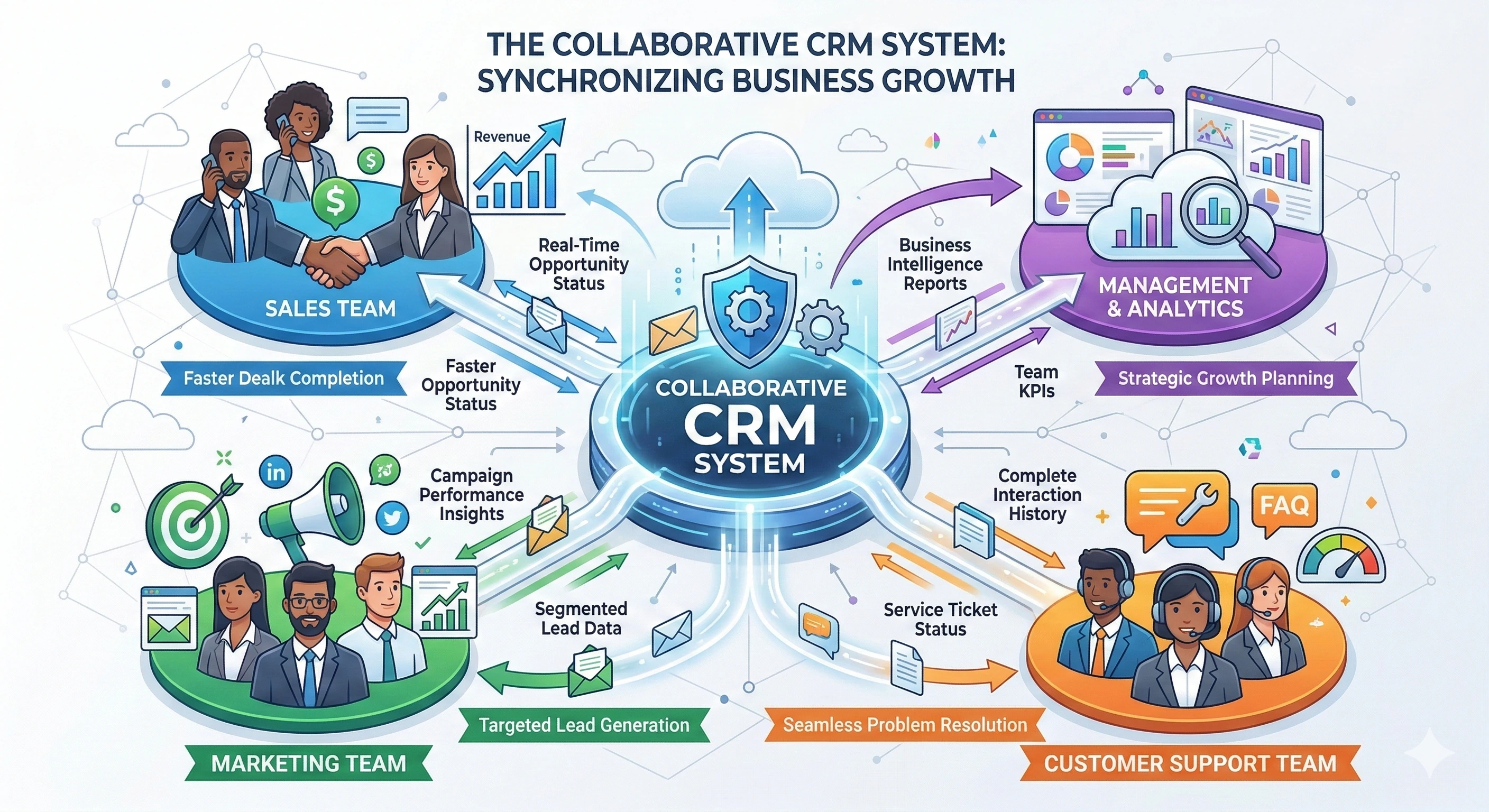
Collaborative CRM software synchronizes various customer data and shared interactions from different departments like Sales, Marketing and Support and from different channels such as phone, fax, email, Social, Mobile, and the web; to both enhance the communication and provide a full 360-degree view of the customer. A true collaborative CRM software solution will help increase customer loyalty and retention.
Advantages of Collaborative CRM systems:
- Cuts down customer service costs.
- Increases the value-add of your products.
- Provides for better up-selling to existing clients.
- Increases customer retention rates and loyalty.
- Helps communicate with, retain and serve more customers with fewer resources.
- Improve channel interactions.
Collaborative CRM software Enhances Customer Satisfaction: By using collaborative CRM software your company will streamline sales, marketing and customer support processes resulting in enhanced company-wide communication and Customer Satisfaction. No longer will your customers have to repeat themselves to different sales or support representatives as all information is shared in real time. Important private and public customer information can be shared based on user-permessions for the team to take advantage of. Customers now will feel heard and important when talking to your employees. Less time is wasted searching for answers to questions, leaving more time to work on the Relationship. Collaborating with the stakeholders streamlines business processes and help achieve business goals sooner. This reduces customer and employee frustration levels, allowing for a better quality experience for the Customer. Test drive the Salesboom Collaborative CRM software solution now.