




Follow Salesboom's proven four-phase CRM implementation framework to align your teams, migrate your data, and drive lasting user adoption from day one.
back to HomeOrganizations that treat CRM deployment as a simple IT installation — rather than a business transformation initiative — consistently run into costly, avoidable problems that no amount of good software can fix.
Without visible leadership commitment, CRM initiatives stall. Teams treat the platform as optional, adoption plateaus, and the project loses momentum weeks after go-live when the initial energy fades.
Configuring a CRM without defining clear success metrics first creates a platform that technically works but fails to solve any specific business problem — leaving stakeholders questioning the investment's value.
Systems go live but never get used when training is rushed or skipped. Teams revert to spreadsheets and email threads — and revenue opportunities slip through the cracks of an unused platform.
Corrupt records, missing relationships, and broken field mappings erode trust in the platform from day one. Teams that find bad data on launch day rarely fully trust the system again — regardless of technical fixes.
When CRM workflows are configured based on assumptions rather than mapped business processes, the platform creates friction instead of removing it — driving user resistance that is difficult to overcome post-launch.
Poor communication and zero involvement before launch leave employees feeling a CRM was imposed on them rather than built for them — creating the resistance that kills adoption long before usage data reveals the problem.
A phased methodology built for real business — dividing implementation into four structured 10-day phases with defined milestones, clear ownership, and specific deliverables at every stage.
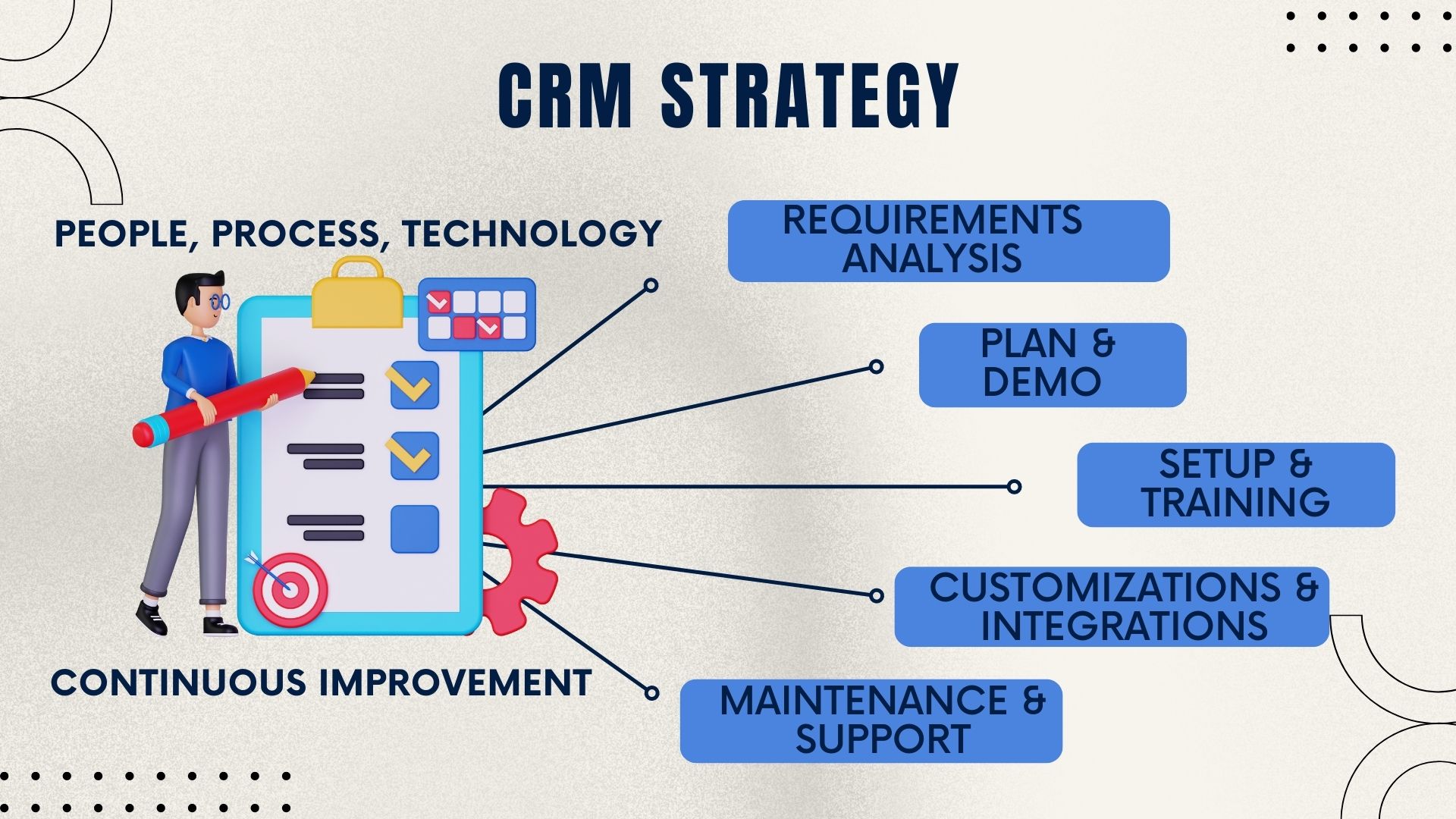
Each phase has a distinct focus, ensuring the right work happens in the right order — and that nothing critical gets skipped in the rush to reach launch day.
The foundation is laid before any configuration is touched. Executive commitment is formalized, the project team and CRM administrator are selected, and all stakeholders align on goals and timeline.
The CRM environment is built to reflect actual business workflows. Administrators customize the platform to match operational needs while training materials are prepared in parallel.
The most technically sensitive stage. A disciplined test-then-import approach ensures business data arrives clean, accurate, and properly mapped before the system goes live.
Technical deployment shifts to human adoption. The platform becomes a core part of everyday workflows rather than another tool employees work around or ignore.
With 22+ years of CRM implementation experience across 159 countries, Salesboom brings a depth of rollout expertise that generic CRM vendors simply cannot match.
A structured, battle-tested framework built on 22+ years of real-world CRM implementation experience — not a theoretical checklist written by consultants who have never managed a rollout themselves.
Expert CRM specialists — not chatbots — guide your team through every phase, from kickoff through post-launch optimization. Real people who have seen every implementation challenge there is.
Pre-built workflow templates accelerate Phase 2 configuration and ensure your CRM reflects proven best practices for your industry — reducing build time and eliminating configuration guesswork.
Native Outlook and QuickBooks integration, plus an open API for connecting your existing ERP, marketing, and support platforms — ensuring the CRM fits into your existing technology stack from day one.
No hidden implementation fees, no vendor lock-in, and predictable monthly pricing starting at $14/user — so your rollout budget stays on track without surprise charges appearing after the contract is signed.
Organizations across 159 countries have used Salesboom to successfully implement CRM and transform their operations — a global track record of implementation success that no marketing claim can manufacture.
One of the most common implementation mistakes is leaving the entire rollout to IT. Salesboom's framework distributes responsibility across five organizational groups — because CRM success is a team sport.
Provide strategic direction, communicate organizational priority, reinforce adoption expectations, and ensure the project receives the resources it needs. Without visible executive support, CRM initiatives stall — no matter how good the technology.
Coordinate the full 40-day rollout, manage the implementation timeline, bridge communication between technical and business stakeholders, and ensure milestones are hit on schedule without escalating scope or cost.
Configure the CRM platform, manage user accounts and permissions, monitor data quality, and serve as the internal subject-matter expert for ongoing system management and user support throughout and after the rollout.
Manage system integrations, build custom solutions where needed, support technical architecture decisions, and ensure the CRM connects seamlessly with existing business tools — especially critical during Phases 2 and 3.
Sales reps, service agents, and managers who use the CRM daily. Their adoption ultimately determines the system's ROI. Involving them early in the process — and training them thoroughly before go-live — is non-negotiable for implementation success.
Each phase of the 40-day framework contains specific best practices that prevent the most common — and most expensive — implementation failure points.
A structured CRM implementation is not just about going live on time. It is about building a centralized business platform that compounds in value over months and years.
Leaders gain full visibility into sales pipelines, service queues, and customer health — in real time, without asking anyone for a status update or waiting for end-of-week spreadsheet reviews.
Confident forecasting, faster course correction, data-driven decisionsA well-configured CRM breaks down silos between sales, service, and marketing — putting every team on the same page with shared customer data and coordinated workflows that eliminate duplicated effort.
Seamless handoffs, fewer dropped balls, customers never repeat themselvesWith Salesboom's modular architecture, additional functionality, users, and integrations can be added at any stage without costly reimplementation — a CRM investment that grows with your business.
Growth enabler, not bottleneck — scales from 5 users to 5,000+Every CRM implementation carries risk. Salesboom's 40-day framework is specifically designed to surface and neutralize those risks before they become expensive, hard-to-reverse problems.
Executive kickoff and stakeholder alignment eliminate conflicting expectations before any configuration work begins — the single most common root cause of implementations that drift off-scope and over-budget.
Business process mapping and administrator training ensure the platform is built to reflect real workflows, not assumptions — preventing the friction that drives user resistance and abandonment post-launch.
Test migrations and structured validation protocols catch field mapping errors and corrupt records before full import — preventing the data trust collapse that derails otherwise well-executed implementations.
Structured training, usage monitoring, and feedback loops identify and address adoption gaps before they become permanent habits — the difference between a CRM that transforms operations and one that gathers dust.
Early technical review and phased integration planning prevent last-minute connection failures that delay go-live dates and erode stakeholder confidence in the project team and the platform simultaneously.
Comprehensive documentation of configuration decisions, field mappings, and workflow logic protects the implementation investment from staff turnover — one of the most overlooked risks in any CRM rollout project.
Straightforward answers based on 22+ years of real-world CRM rollout experience — for organizations actively planning or evaluating a CRM implementation project.
Everything you need to plan, execute, and optimize your Salesboom CRM implementation — from service level agreements to data security and licensing guidance.

Review Salesboom's CRM service level agreement — including the 99.8% uptime guarantee, refund policy, and dedicated service monitor that gives your implementation team confidence in platform reliability throughout rollout and beyond.

Access Salesboom's comprehensive CRM implementation guide — detailed documentation covering every aspect of the 40-day rollout framework, from stakeholder preparation through post-launch optimization and long-term CRM management.

Explore Salesboom's structured CRM implementation plans — matching your organization's size, complexity, and industry requirements to the right rollout approach, support level, and timeline for achieving CRM go-live success.

Understand how Salesboom protects your organization's data by reviewing our data networking and security documentation — covering encryption standards, infrastructure security, and compliance considerations critical during your CRM implementation planning.

Download the visual CRM implementation timeline chart — a printable 40-day roadmap showing all stakeholder responsibilities, phase milestones, and key deliverables your project team can use to manage the rollout from day one.
Get a personalized walkthrough of the Salesboom 40-day CRM implementation framework and see how our specialists guide your team from Day 1 to a fully adopted, revenue-driving CRM platform.
Questions? Call: 1-855-229-2043
Discover powerful CRM editions to scale your business efficiently.
A complete CRM suite with Marketing Automation, ERP integration, and Support tools — built for performance and value.
Explore ProfessionalFor large enterprises — automate workflows, unify data, and leverage analytics to drive strategic growth.
View EnterprisePerfect for small teams starting with CRM — manage leads, track sales, and boost productivity with simplicity.
Discover Team